For many, a smart home is not one that has a thermostat that responds to their temperature needs, a door lock that knows they are coming up the drive, or even a fridge that knows when they have run out of milk.
Instead it is one that is comfortable, affordable and in the right location.
Unfortunately for many that remains a distant dream, begging the question – can technology play a role in making housing more affordable and better suited to our needs?
Alastair Parvin certainly thinks so. He is the brains behind the WikiHouse, an open source building system which aims to give people the digital tools to create cheap homes.
Mr Parvin believes that digital technology could transform the way we design and build our homes and hopes that his project can do for buildings what Uber and AirBnB have done for the taxi and hotel industries respectively.
“There is something fundamentally wrong with our housing economy – our dependence on a few large development companies to buy the land, beat their way through local community resistance and build rows of poor quality, unsustainable mass housing that fewer and fewer of us can afford,” said Mr Parvin.
“Every major urban economy now faces a huge housing challenge. It’s not just about building enough homes but also about breaking our dependence on fossil fuels and debt.”
To draw up plans for their new home, users will visit the WikiHouse website (still under construction) and input some basic measurements such as the width and height, which algorithms will interpret and use to predict how much the project will cost and even how many screws it will need.
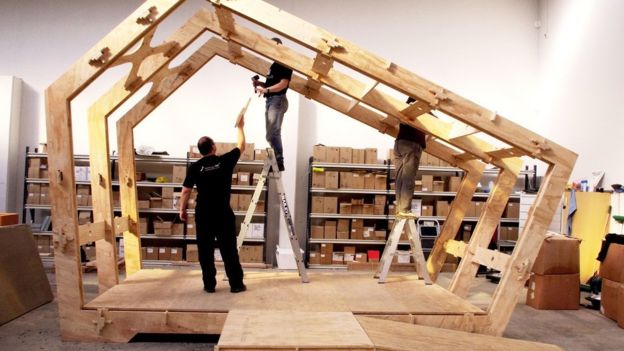
The components for the house will not be manufactured in centralised factories but by a distributed network of small businesses and community spaces where people get together to create things (maker-spaces).
“These micro-factories will be collectively one big factory rather like AirBnB is a huge hotel,” said Mr Parvin.
Possible kits include studios (with an estimated build price of £12,000), micro houses (£45,000) and town houses (£150,000).
Much of the material is deliberately low-tech – timber frames that can be put together, said Mr Parvin “using tools you can buy in B&Q”.